
A practical guide for Responsible Persons, landlords, managing agents and business owners
Grey Knight Solutions Ltd • UK Fire Safety & Compliance Knowledge Hub
A fire risk assessment is not a document to complete once and forget. It is a live management tool that should reflect the building, the people who use it and the fire precautions actually in place.
One of the most common questions we hear is: “How long is a
fire risk assessment valid for?” The important point is that UK fire safety law
does not give every premises a universal expiry date. Instead, the Responsible
Person must keep the assessment under regular review and update it when there
is reason to suspect it is no longer valid or when there has been a significant
change.
|
The short answer |
What does the law actually require?
For premises within the scope of the Regulatory Reform (Fire Safety) Order 2005 in England and Wales, Article 9 requires the Responsible Person to make a suitable and sufficient assessment of fire risk. Article 9(3) then requires that assessment to be reviewed regularly and revised where necessary. This is an important distinction: the legal duty is to maintain a suitable and sufficient assessment, not simply to possess an old report.
Home Office guidance follows the same five-step approach: identify fire hazards; identify people at risk; evaluate, remove, reduce and protect from risk; record, plan, inform, instruct and train; and review. The review stage is therefore part of the risk-assessment process itself, not an optional administrative exercise.
When should an FRA be reviewed?
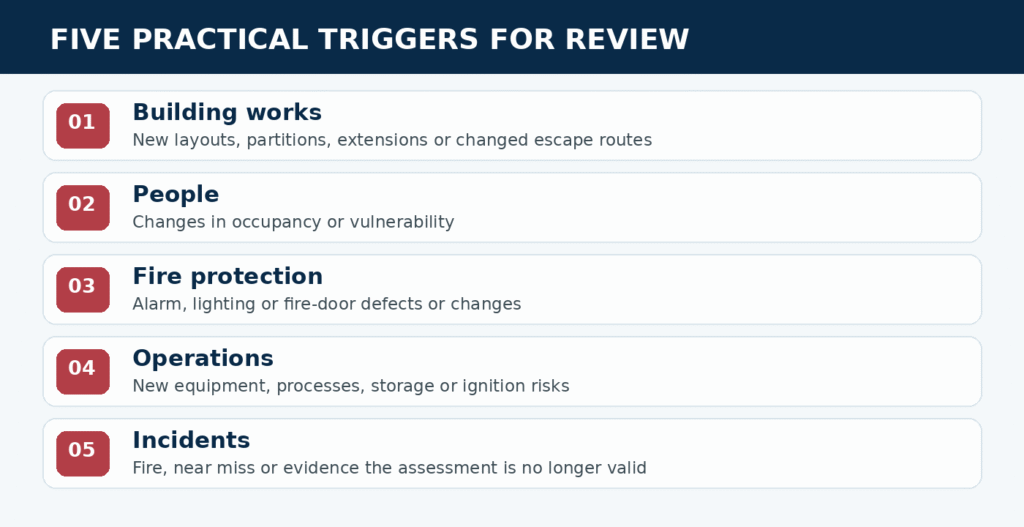
A sensible review programme should consider the risk profile of the premises. Many organisations choose an annual management review as a practical control, but that should not be confused with a universal legal expiry period. A review may be needed much sooner if circumstances change.
Alterations to the building
Changes to layout, extensions, conversions, new partitions, changes to escape routes or significant refurbishment can affect travel distances, compartmentation, fire doors and evacuation arrangements.
Changes in occupancy or vulnerability
A significant increase in numbers, new sleeping accommodation, children, older people, disabled persons or residents requiring assistance may materially change the assessment.
Changes to processes or fire load
New cooking equipment, machinery, charging arrangements, hazardous substances, storage practices or increased stock can introduce new ignition sources or fuel.
Failure or alteration of the precautions
Problems with fire alarms, emergency lighting, fire doors, sprinklers, smoke control or other life-safety systems can change the level of risk.
Fire, near miss or evidence the assessment is no longer valid
An incident may reveal weaknesses that were not previously identified. The assessment should be revisited and the findings incorporated into the fire-safety arrangements.
Does “review” always mean a completely new assesssment?
Not necessarily. A review is a structured check that the existing assessment remains suitable and sufficient. Where there have been no material changes and the controls remain effective, the outcome may be to record the review date and confirm that the assessment remains valid. Where significant changes have occurred, or the original assessment is inadequate, a more substantial revision or a new assessment may be necessary.
A practical case study
Illustrative case study – converted commercial premises Lesson: the date on the front of an FRA matters less than whether the assessment still reflects the premises and its risks. |
When should a good FBA review check?
· Whether the premises, use and occupancy still match the assessment
· Whether people especially at risk have been considered
· Whether escape routes and final exits remain suitable and unobstructed
· Whether fire detection, alarm, emergency lighting and firefighting equipment remain appropriate and maintained
· Whether fire doors and compartmentation remain effective
· Whether staff information, training, drills and emergency arrangements remain current
Whether previous significant findings have been completed or require escalation
Who is responsible?
The legal duty remains with the Responsible Person. A competent fire risk assessor can assist with the assessment and provide professional recommendations, but appointing a consultant does not transfer the Responsible Person’s underlying statutory duties.
When should you bring in a competent fire risk assessor?
Simple premises may sometimes be assessed internally by someone who is genuinely competent to do so. Professional assistance becomes increasingly important where the building is complex, provides sleeping accommodation, accommodates vulnerable people, has significant fire-engineered features, has undergone material alterations, or where the Responsible Person is uncertain whether the existing assessment remains suitable and sufficient.
|
Grey Knight Solutions
can help |
Frequently asked questions
Does a fire risk assessment expire after 12 months?
There is no universal statutory 12-month expiry date. The assessment must be reviewed regularly and updated when required. An annual review can be a sensible management interval for many premises, but the appropriate frequency depends on risk and change.
Do I need a new FRA after refurbishment?
Potentially. If refurbishment changes layout, escape, compartmentation, occupancy, processes or fire precautions, the assessment should be reviewed and revised as necessary.
Can I just change the date on the old FRA?
No. A meaningful review should check whether the assessment still reflects the premises, people, hazards and controls. Simply changing the date would not demonstrate that.
Who can carry out the assessment?
The Responsible Person must ensure the assessment is suitable and sufficient. Where they do not have the necessary competence, they should obtain assistance from a competent person.
Need your fire assessment reviewed?
If your premises have changed, your previous actions remain outstanding, or you are unsure whether your current FRA is still suitable, contact Grey Knight Solutions Ltd. We provide practical fire risk assessments and compliance support across Greater Manchester and beyond.
BOOK/ENQUIRE: www.greyknightsolutions.com | 0161 833 7533
Authoritative sources & further reading
· Regulatory Reform (Fire Safety) Order 2005 – Article 9: https://www.legislation.gov.uk/uksi/2005/1541/article/9
· Home Office – Fire safety risk assessment: 5-step checklist: https://www.gov.uk/government/publications/fire-safety-risk-assessment-5-step-checklist/fire-safety-risk-assessment-5-step-checklist-accessible