
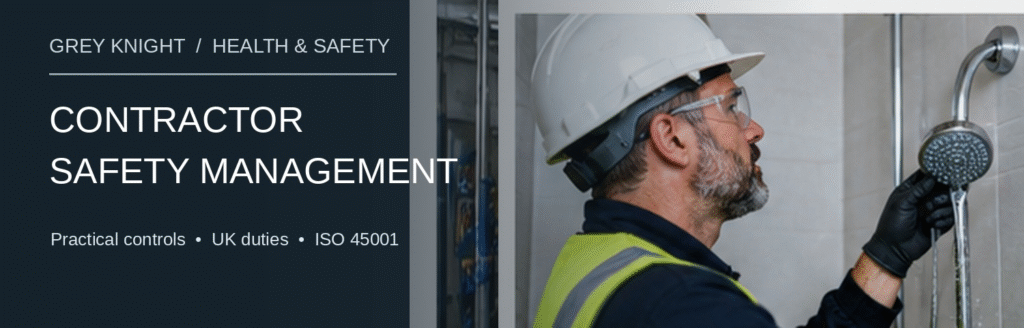
From planned maintenance and electrical repairs to refurbishment and specialist servicing, bringing a contractor onto your premises introduces risks that may not exist during normal operations. The critical question is not simply whether the contractor has supplied paperwork. It is whether the work can be carried out safely alongside your people, visitors and day-to-day activities.
Why contractor safety deserves attention in 2026
The Health and Safety Executive (HSE) reported on 1 July 2026 that 126 workers died in work-related incidents in Great Britain during 2025/26. Construction accounted for 25 deaths, while falls from height were the most common cause across all sectors, accounting for 31. These figures are not a measure of contractor incidents specifically, but they underline why work planning, supervision and control of higher-risk tasks matter.
For employers, facilities managers, landlords and commercial property operators, the challenge is often the interface between two organisations: the contractor understands the task, while the premises operator understands the building, occupants and existing hazards. Both perspectives are needed before work begins.
Who is responsible when a contractor works on your site?
Under the Health and Safety at Work etc. Act 1974, employers have duties to protect employees and, so far as reasonably practicable, people who may be affected by their undertaking. The Management of Health and Safety at Work Regulations 1999 require relevant cooperation and coordination where employers share a workplace. Appointing a contractor does not automatically transfer all health and safety responsibilities away from the business commissioning the work.
Where the activity meets the definition of construction work, the Construction (Design and Management) Regulations 2015 (CDM 2015) may impose additional duties. These can apply to smaller commercial refurbishment and maintenance projects, not just major building sites. Commercial clients must make suitable management arrangements; projects involving more than one contractor require appropriate principal designer and principal contractor appointments. Not every routine servicing task is necessarily construction work, so the scope should be considered rather than assumed.
Seven checks to make before work starts
1. Define the work and its boundaries
Agree exactly what is being done, where, when and by whom. Identify whether the task will affect occupied areas, escape routes, deliveries, essential services or other contractors. A vague job description makes it difficult to assess the actual risks.
2. Check capability, not just certificates
Ask for evidence appropriate to the work: relevant skills, experience, training, supervision, equipment and, where relevant, professional registrations or trade-specific competence. Accreditation can be useful evidence, but a certificate alone does not prove that the proposed team can control the risks of your particular job.
3. Review task-specific risk controls
Obtain and review suitable risk assessments and safe systems of work where appropriate. For complex or higher-risk activities, method statements and permits-to-work may be necessary. Look for practical controls for work at height, electrical isolation, hot work, hazardous substances, lifting, dust, noise and access—not generic documents copied from another site.
4. Share site-specific information
Explain the hazards the contractor could not reasonably know from the job description: asbestos information where relevant, fragile surfaces, restricted areas, buried services, plant isolation points, emergency arrangements and occupied spaces. The contractor should also explain risks that its activities may create for your staff and the public.
5. Coordinate people, access and timing
Confirm who will supervise the job, who authorises changes, how work areas will be segregated and whether other activities must stop. Plan deliveries, vehicle movements, noisy work and temporary service interruptions. Where several contractors are involved, coordination must be explicit rather than assumed.
6. Provide an effective induction and emergency arrangements
A short, relevant induction should explain access, welfare, incident reporting, first aid, fire arrangements and the site-specific controls that matter. Verify that the workers arriving are the people expected and understand the agreed method. For construction work, CDM 2015 includes specific site-induction and welfare requirements.
7. Monitor the work and close it out properly
Do not treat approval of documents as the end of the process. Check whether controls are followed, respond to changes and stop unsafe work where necessary. At handover, confirm that isolations are removed safely, guards and barriers are reinstated, waste is cleared and any relevant certificates, inspection records or updated information are received.
The risk is often at the interface between jobs
Consider a maintenance contractor working in a plant room while a second contractor carries out electrical alterations nearby. Each may have a reasonable method for its own task, yet the combined activities can introduce new hazards: conflicting isolations, restricted access, dust exposure, disrupted ventilation or emergency access. A short coordination discussion before work begins can reveal issues that neither contractor’s individual assessment addresses.

image: shared workspaces and service systems require coordinated controls.
How ISO 45001 can improve contractor management
ISO 45001 provides a structured occupational health and safety management framework. It encourages organisations to manage outsourced activities and contractor interfaces through planning, operational controls, communication, monitoring and improvement. In practice, this can mean consistent contractor approval criteria, clearer responsibilities, proportionate risk review, incident learning and periodic checks that procedures work on site.
ISO 45001 certification is not a general legal requirement for UK businesses, and it is not a substitute for complying with health and safety law. HSE also cautions against treating certification alone as proof of effective control. An organisation can apply relevant management-system principles without pursuing certification, provided it does not incorrectly claim full conformity.
A practical approach for smaller businesses and property managers
A small business does not need an unnecessarily complicated contractor approval system. A proportionate arrangement may be a brief scope-of-work form, evidence of competence, a task-specific risk review, a record of site hazards communicated, a named point of contact and a close-out check. More hazardous or complex work will need greater detail and oversight. The objective is an auditable trail of sensible decisions—not paperwork for its own sake.
For managing agents and landlords, contractor management should also connect with existing fire risk assessments, asbestos management information, maintenance records and resident or tenant communications where applicable. A contractor may be competent at the task but still need information about the building and its occupants.
How Grey Knight Solutions can help
Grey Knight Solutions Ltd supports organisations with practical health and safety consultancy, risk assessment reviews, compliance audits and ISO 45001 gap analysis. We help clients identify where contractor arrangements are unclear, where evidence is missing and where day-to-day controls need strengthening—without turning straightforward work into an unnecessarily bureaucratic process.
If you are planning maintenance, refurbishment or contractor-led work and want greater confidence in your arrangements, contact Grey Knight Solutions to discuss a proportionate compliance review. Visit greyknightsolutions.com or call 0161 883 7533.